

Health
A Boat-Based Initiative is Helping Akwa Ibom Reach Zero-Dose Children in Remote Riverine Communities


Kenneth Ibe and Abara Erim (Lead Writers)
In a small, isolated fishing community in Eastern Obolo, Akwa Ibom State in Nigeria’s south-south region, Ekong Asuquo, a resident of the community sits by the river, her eyes distant and heavy with grief. It has been a year since she lost two of her children to a measles outbreak that swept through their coastal village. “I remember their tiny bodies burning with fever,”
There are no roads leading to Asuquo’s village and the only way to reach the mainland is by boat. Asuquo said that by the time the outbreak reached her home, there was nothing she could do. “I still wonder, if we had vaccines here, will they [my children] still be with me?”
In many floating or semi-permanent settlements, there is a general lack of access. In most cases only canoes and boats are the method of transportation. This leaves children vulnerable, often suffering from a lack of basic healthcare infrastructure and services. “We were trapped, unable to get help in time” Asuquo noted.
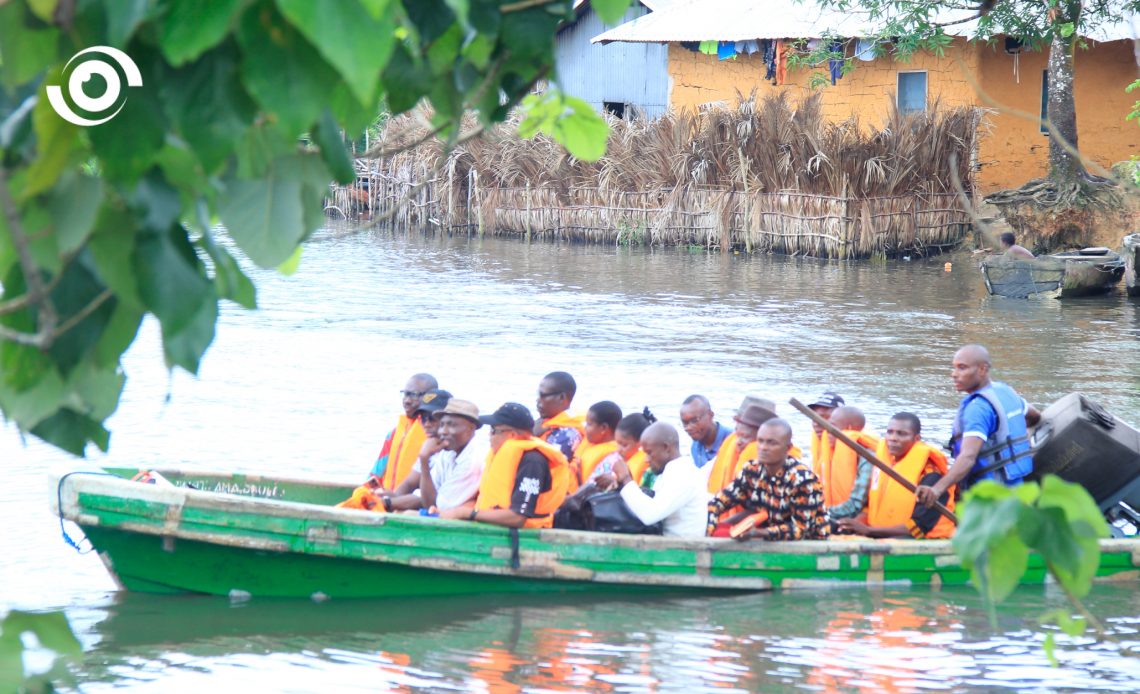
The river bank at which vaccines are delivered to the isolated fishing community in eastern Obolo, Akwa Ibom State. Image credit: Nigeria Health Watch.
Immunisation remains the cornerstone for preserving children’s health. According to the Nigeria Strategy for Immunisation and PHC System Strengthening (NSIPSS), the country has 4.3 million unvaccinated children, the highest number in the world.
In a Multiple Indicator Cluster Survey (MICS) conducted in 2016/2017, 77% of children aged 12–23 months did not receive any vaccine at all. This highlights the need for governments and stakeholders to implement strategies to boost immunisation coverage and uptake. Efforts to make vaccination available to hard-to-reach communities are critical in leaving no one behind, as these areas often face significant barriers such as geographic isolation, limited healthcare infrastructure, and socio-economic challenges.
Recognising the urgent need to address the lack of access to vaccines in such communities, the Akwa Ibom State Primary Healthcare Development Agency (ASPHCDA) devised an innovative solution to ensure that no child is left behind by launching the Mid-Sea Vaccination programme.
The programme takes into consideration geographic access as a limitation to vaccine coverage and recognises that traditional healthcare service delivery methods will not be effective in providing this essential requirement. Hence, vaccine delivery is distributed through speedboats instead of waiting for the people to come to the mainlands to access these vaccines.
Nigeria still remains the host to the second largest number of zero-dose children in the world, with millions of children having never received or facing formidable barriers to accessing essential healthcare services, including vaccines.
The state agency explored the strategy of using speed boats and equipping health workers with tools such as life jackets, enabling them to navigate the rivers safely to take vaccines to the coastal communities.
However, the strategy is not just about delivering vaccines, they also engaged the community members, educating them about the importance of immunisation, and ensuring that every child, no matter how remote their location is, has access to life-saving vaccines.
“When they told us the health workers were coming, I couldn’t believe it,” says Emem Udoh, a resident of Eastern Obolo LGA and a mother of three. “I have always worried about my children getting sick, especially with all the talk of diseases we don’t even know about. But now with the vaccines, I feel like they are safe. It’s one less thing to worry about.”
An interractive session between Nigeria Health Watch representatives and community members.
Image Credit: Nigeria Health Watch.
According to Dr. Eno Attah, the Executive Secretary of ASPHCDA, the Mid-Sea Vaccination programme is aimed to support the coastal communities in strengthening Routine Immunisation structures and improving the immunisation outcomes in the state.
“Vaccinating children in mid-sea communities isn’t just about protecting them from diseases; it’s about making sure they aren’t forgotten.” she added. ‘’
The success of this approach has broader implications. It highlights the importance of tailored healthcare solutions that consider the unique needs and lifestyles of different communities. For Akwa Ibom’s riverine populations, the boat has become a symbol of hope — a vessel that carries not just vaccines, but the promise of a healthier future.
“The boat coming to our village was like a miracle,” says Chief Inyang Otu, a community leader in one of these riverine settlements. “For years we felt forgotten but now we know we are not alone. The children in our community can now be safe from diseases we thought we couldn’t prevent.”
For others, the initiative has brought a renewed sense of community and trust in the healthcare system. “We’ve seen the health workers come before, but this time it feels different,” says Etebong Akpan, a fisherman in Eastern Obolo. “They made the effort to come all the way to us. It shows that they care. I made sure my children got their shots because I don’t want them to suffer from diseases we can prevent.”
According to Antatica Ukoimam, the Health Promotion Officer in Eastern Obolo LGA, the process of delivering and administering vaccines to communities include more than just logistical difficulties. She noted that one of the challengs is “combating misinformation, which often discourages community members from trusting vaccines.
“It is sometime so bad that before we get there with the vaccines, misinformation has gotten there.” However, the agency has strategically leveraged the influence of community leaders, traditional rulers, and key stakeholders to build trust within these communities.
Through this collaborative effort, they have been able to sensitise community members about the importance of vaccines and health programmes, ensuring that vital health services reach even the most isolated populations.
Ensuring that every child in Nigeria receives life-saving vaccines, regardless of where they live, is a mission that requires innovative thinking, collaboration, and exceptional commitment. By leveraging mobile vaccination boats, forming partnerships with local fishermen, empowering community health workers, and improving maritime infrastructure, healthcare agencies are breaking down barriers and bringing hope to coastal communities in Akwa Ibom.
(Nigeria Health Watch)


Gombe Governor Mourns as Five Children of Same Father Die in Tragic Road Accident
Our Editor The governor of Gombe State, Muhammad Inuwa Yahaya, has expressed grief over the death of five children belonging...


Taraba Attack Death Toll Rises to 62, 52 Injured, Thousands Displaced
Our Editor The death toll in Friday’s gunmen attack on Binnari community in Karim-Lamido Local Government Area of Taraba State...


Taraba Killings: Gov Kefas Postpones Lamido Gashaka’s 10th Anniversary, Zing LGA’s 50th Anniversary as Death Toll Hits 57
By Andrew Ojih, Jalingo Taraba State Governor, Agbu Kefas, has ordered the postponement of the 10th anniversary celebration of the...


APM Inaugurates Caretaker Committee in Bauchi, Shehu Daji Named Chairman
From Paul Orude Bauchi The National Chairman of the Allied Peoples Movement (APM), Alhaji Yusuf Mamman Dantalle, on Tuesday inaugurated...


Gratuities: Bauchi Pays N5.2bn to 2737 Retirees, Begins 2015 Payments Monday
From Paul Orude Bauchi Bauchi State government has disbursed the total sum of N5.2 billion in gratuities to no fewer...


Taraba Attack Claims Over 40 Lives as TSEMA Distributes Relief Items to Victims
By Andrew Ojih, Jalingo. Following the Friday midnight attack that claimed over 40 lives in Binnari community in Karim Lamido...


World Polio Day: Bauchi First Lady Urges Vaccination as UNICEF, Rotary Renew Eradication Call
From Paul Orude Bauchi Hajia Aisha Bala Mohammed, wife of the Bauchi State Governor, Sen. Bala Abdulkadir Mohammed, has urged...


Crisis Hits Bauchi APM as Faction Suspends Chairman Auwal Isah
From Paul Orude, Bauchi A crisis has hit the Allied Peoples Movement (APM) in Bauchi State, as the party’s secretary...


2027: Bauchi APM Sues INEC, PRP, Shehu Buba Over PRP Governorship Candidacy Eligibility
From Paul Orude, Bauchi The Allied Peoples Movement (APM) has filed a suit at the Federal High Court, Bauchi, challenging...


Minorities Hold No Key Office in Toro Despite 60% Population – 48 Groups Cry Out
From Paul Orude, Bauchi The Chairman of the Conference of Autochthonous Ethnic Nationalities Community Development Associations (CONAECDA), Bauchi State chapter,...
-

 Crime6 days ago
Insecurity: Court Orders Handover of Assorted Firearms to NCCSALW
-
News6 days ago
Crisis Hits Bauchi APM as Faction Suspends Chairman Auwal Isah
-
News3 days ago
Gratuities: Bauchi Pays N5.2bn to 2737 Retirees, Begins 2015 Payments Monday
-
News4 days ago
World Polio Day: Bauchi First Lady Urges Vaccination as UNICEF, Rotary Renew Eradication Call
-
News3 days ago
Taraba Attack Claims Over 40 Lives as TSEMA Distributes Relief Items to Victims
-

 Business and Economy6 days ago
NEDC Distributes Starter Packs To 20 Beneficiaries For Eco-Friendly Stove, Briquette Production In Bauchi
-

 Education5 days ago
Taraba: ASUSS, Federal Mortgage Bank Partner to Build 350 Housing Units for Secondary School Teachers
-

 Politics4 days ago
2027: APM Sues INEC, PRP, Deputy Governorship Candidate Over Eligibility